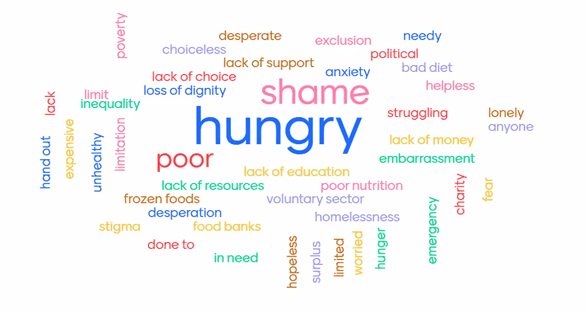
Knight (2017) states poverty has a negative impact on a child’s life and how emotional damage is an outcome for a child living in certain conditions. When children are brought up in poverty a cycle begins which can be viewed as an normal way of living, leading the child to remain in this process. Once the child becomes an adult they have been influenced by parents to repeat this way of living and bring their own children up in society as a poor child (Leseman and Slot, 2014). As a young child I was brought up in a family structure of a lone parent family, the household income came from relying on financial support from the government and therefore access to food was a struggle. I had no other choice but to accept this way of living and accepted that this was the norm.
Reflecting back to my childhood, I was dependant on school meals, my mother would wait patiently for a child benefit payment each week, the money provided by the social security services would be for domestic expenses such as payment towards electricity and purchasing products to keep my home clean, there was no room for personal luxuries and family holidays. The food available would consist of the bear minimal by depending on what was available on the discounted shelves of the local supermarket, and in some situations we would go hungry.
As a child, I was always appreciative of what a school environment had to offer as I came from a poor environment, and at times school was a safe and supportive environment that was my saviour during hardship. Some practitioners will never know the struggles of what a child faces in their life. Ownership to poor living conditions is very difficult to admit to, therefore to prevent stigma or embarrassment, free school meals would help to end distress or inequalities (Child Poverty Action Group, 2023)
According to Azarieva et al (2022) ”Children are particularly vulnerable to food insecurity, which may cause irreversible damage to their physical, cognitive, and emotional development”. Schools and nurseries offer children much more than a free school meal, they could potentially provide an emergency safety net to children living in crisis. The department of Education (DfE) created the Holidays activities and food programme (2025) which offers families free meals, access to activities that aim of benefiting a child’s holistic development such as problem solving and meaningful experiences. This programme also considers a child’s health and well-being, and is not just available for families who are entitled to claiming financial support. The local authorities have access to funding that can be allocated to children who are in need of this programme for many other reasons. This programme would have benefited many families and children like myself within my community, living in a low-income home where my basic needs where not being met. While families access this programme, further support and advice is also available, services such as citizens advice and contact details for health professionals are available when in need of referrals or seeking support (DfE, 2025).
If like me you want to end the stigma connected to child food poverty and receiving free school meals please sign my petition. If the government provides free school meals for all primary and early years children then no child will experience inequality and feel different because they are receiving free meals, all children will be treated equal and fairly.
References
Azarieva, J. Berry, E. M. & Troen, A. M. (2022). Child food insecurity in the wake of the COVID-19 pandemic: urgent need for policy evaluation and reform in Israel’s school feeding programs. Israel journal of health policy research, 11(1), 13. Available at: https://pmc.ncbi.nlm.nih.gov/articles/PMC8845395/ [Accessed: 21 May 2025]
Child Poverty Action Group (2023) Why universal free school meals is the right move. Available at: https://cpag.org.uk/news/why-universal-free-school-meals-right-move [Ac cessed: 27 May 2025]
Department for Education (2025) Holiday activities and food programme. Available at: https://www.gov.uk/government/publications/holiday-activities-and-food-programme/holiday-activites-and-food-programme-2024 [Accessed: 21 May 2025]
Knight, B (2017) Rethinking Poverty : What Makes a Good Society?, Policy Press, Bristol. Available from: https://ebookcentral.proquest.com/lib/bolton/reader.action?docID=31187545&ppg=58 [Accessed: 1 May 2025].
Leseman, P. P. M. and Slot, P. L. (2014). Breaking the cycle of poverty: challenges for European early childhood education and care. European Early Childhood Education Research Journal, 22(3), 314–326. https://doi-org.ezproxy.bolton.ac.uk/10.1080/1350293X.2014.912894 (Accessed: 30 May 2025)

 Food For Every Child